Moon Synastry: The Complete Guide to Moon Aspects in Love
Quick answer: Moon synastry compares the Moon in your birth chart with the planets and points in a partner’s chart to show how well you meet each other’s emotional needs. Supportive contacts such as Moon trine Moon or Moon conjunct Venus point to comfort and easy care, while squares and oppositions point to emotional friction that takes conscious effort. No single aspect decides a relationship, so read the full pattern.
Moon synastry is the part of relationship astrology that answers the question most couples actually care about: will we feel safe, understood and at home with each other? Sun signs describe who you are on the surface. Venus describes how you flirt and what you find beautiful. The Moon describes what you need to feel loved when the lights are off, the day was hard and nobody is performing.
This guide walks you through everything that matters in Moon synastry. You will learn what it is, why astrologers treat it as the heart of compatibility, how to read it step by step, what every major Moon aspect means, how Moon house overlays work, and which patterns suggest a soulmate bond or a warning sign. If you want a quick starting point before you dive in, try our free moon soulmate test and then come back to read the deeper layer.
What Is Moon Synastry?
Synastry is the practice of laying two birth charts side by side and studying the angles between one person’s planets and the other person’s planets. Moon synastry narrows that comparison to every contact the Moon makes. Because the Moon rules emotions, instincts, comfort, memory and the way we were cared for as children, these contacts show how two people nurture each other day to day.
Before you start reading aspects, it helps to know how Moon synastry differs from the other compatibility methods you will see online.
Moon Synastry vs Moon Sign Compatibility vs Composite Charts
| Method | What It Compares | What It Shows | Best Used For |
|---|---|---|---|
| Moon sign compatibility | Your Moon sign with your partner’s Moon sign | General emotional style match by element | A quick first read |
| Moon synastry | Your Moon against every planet and angle in your partner’s chart, and the reverse | Specific emotional dynamics, needs and triggers | A detailed relationship reading |
| Composite chart | One blended chart built from the midpoints of both charts | The personality of the relationship itself | Understanding the couple as a unit |
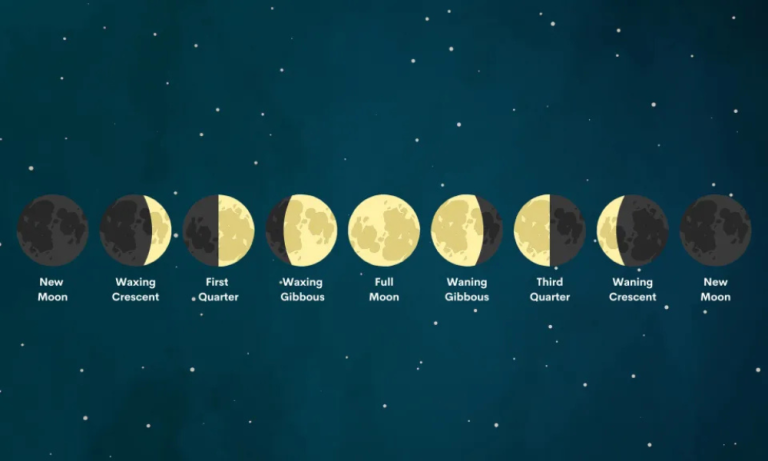
| Moon phase compatibility | The lunar phase each person was born under | Emotional rhythm and life approach | A simple, birth date only check |
Moon sign compatibility is a helpful shortcut, and we cover it in detail in our guide to moon sign soulmate compatibility. Moon synastry goes further because two people with “incompatible” Moon signs can still share a beautiful trine to Venus or a steady contact to Saturn that holds the bond together.
Synastry compares two charts, while the composite chart blends them into one. Our guide to the composite Moon shows the emotional heart of the relationship itself.
Why the Moon Matters Most in Relationship Astrology
Most astrologers treat the Moon as the single most important factor in long term compatibility. The reason is simple. Attraction fades and changes, but the need to feel emotionally safe does not. The Moon shows that need.
The Moon does not always describe what you think you want in a partner. It describes what you need in order to relax. One person may need words of reassurance, another needs practical help, another needs space and quiet. When a partner’s chart naturally supplies what your Moon needs, love feels easy. When it does not, both people can feel unseen even when they care deeply.
Modern relationship research echoes this idea in its own language. The Gottman Institute found that newlyweds who were still married six years later turned toward each other’s bids for connection 86% of the time, while couples who later divorced did so only 33% of the time. In astrological terms, a strong Moon connection describes two people who notice those small bids and answer them without being asked.
The Moon Compared With Other Love Planets
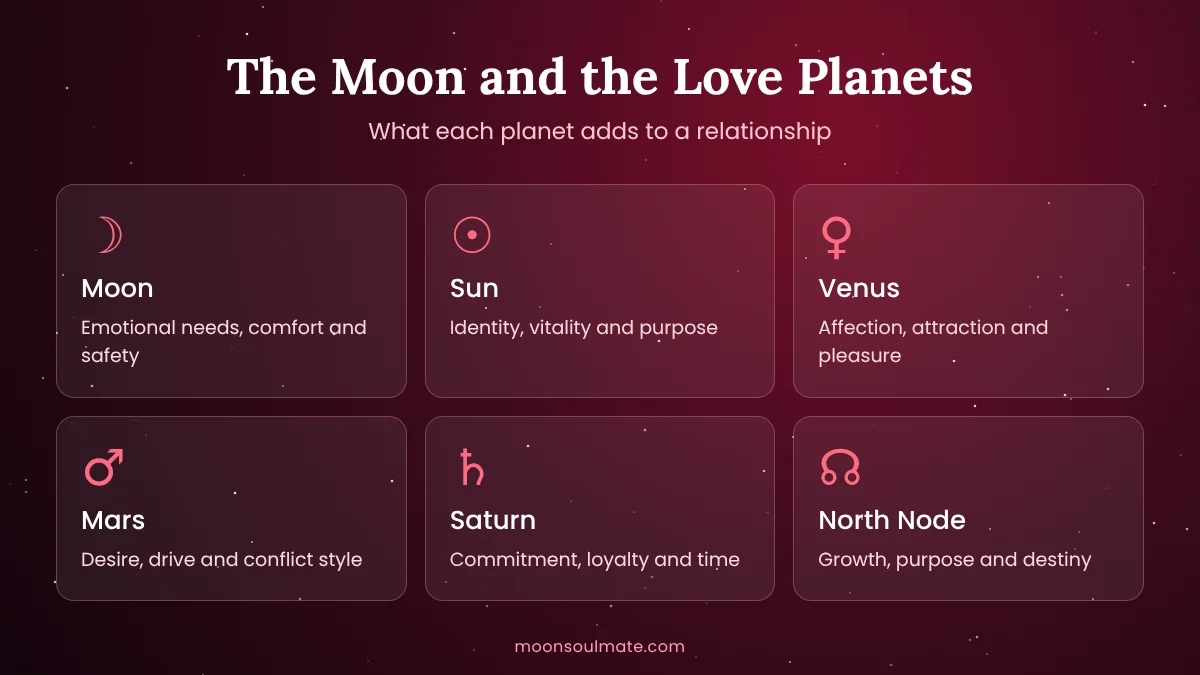
| Planet or Point | Role in Love | Question It Answers |
|---|---|---|
| Moon | Emotional needs, comfort, security | Do I feel safe and cared for with you? |
| Sun | Identity, vitality, purpose | Do you see and support who I am? |
| Venus | Affection, attraction, pleasure | Do I enjoy you and feel adored? |
| Mars | Desire, drive, conflict style | Do we spark, and can we fight fairly? |
| Saturn | Commitment, duty, time | Will this last and can we build together? |
| North Node | Growth, purpose, destiny | Does this bond move my life forward? |
How to Read Moon Synastry Step by Step
Reading Moon synastry is a process, not a single lookup. Work through these five steps in order and you will avoid the most common beginner mistakes.
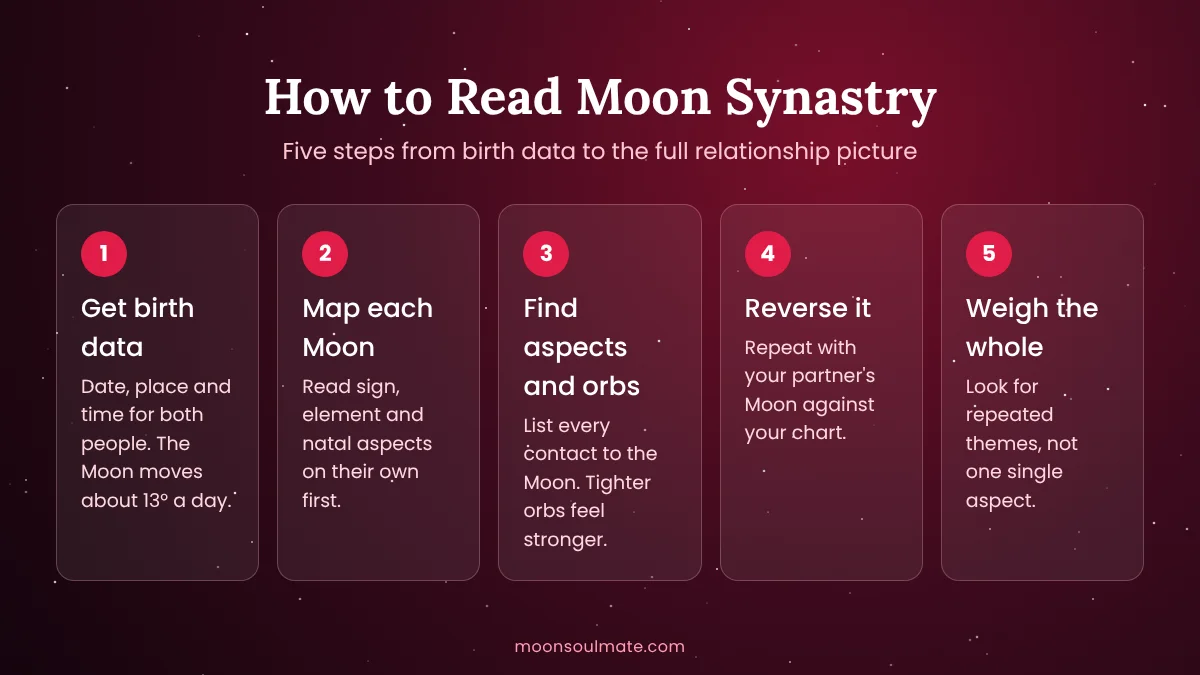
Step 1: Get Accurate Birth Data
You need a birth date, a birth place and ideally a birth time for both people. The birth time matters more for the Moon than for any other planet. The Moon circles the entire zodiac in about 27.3 days, according to NASA, which means it moves roughly 13 degrees a day and changes sign about every two and a half days. A person born at 1 a.m. and a person born at 11 p.m. on the same date can have their Moons in different signs.
If a birth time is unknown, use a noon chart and treat the Moon’s exact degree as an estimate. Aspects with a wide margin are still worth reading, while tight aspects may not hold.
Step 2: Map Each Person’s Moon on Its Own
Before you compare anything, read each Moon alone. Note its sign, its element and its aspects inside that person’s own birth chart. A Moon in Cancer that squares Saturn natally already carries a fear of rejection, and that fear will show up in every relationship. Synastry then shows whether a partner soothes or presses on that sore spot. Our article on finding your soulmate in the natal chart explains how to read these personal placements.
Step 3: Find the Aspects and Check the Orbs
Next, list every planet and angle in your partner’s chart that forms an aspect to your Moon. An aspect is a specific angle between two points, and the orb is how close to exact that angle is. Tighter orbs feel stronger.
| Aspect | Angle | Typical Synastry Orb | Feel in a Relationship |
|---|---|---|---|
| Conjunction | 0° | Up to 8° | Fusion, instant familiarity, high intensity |
| Sextile | 60° | Up to 4° | Friendly support that grows with effort |
| Square | 90° | Up to 6° | Friction, attraction, growth through tension |
| Trine | 120° | Up to 6° | Natural ease and emotional flow |
| Opposition | 180° | Up to 6° | Magnetic pull between opposites |
| Quincunx | 150° | Up to 3° | Constant small adjustments and mismatched timing |
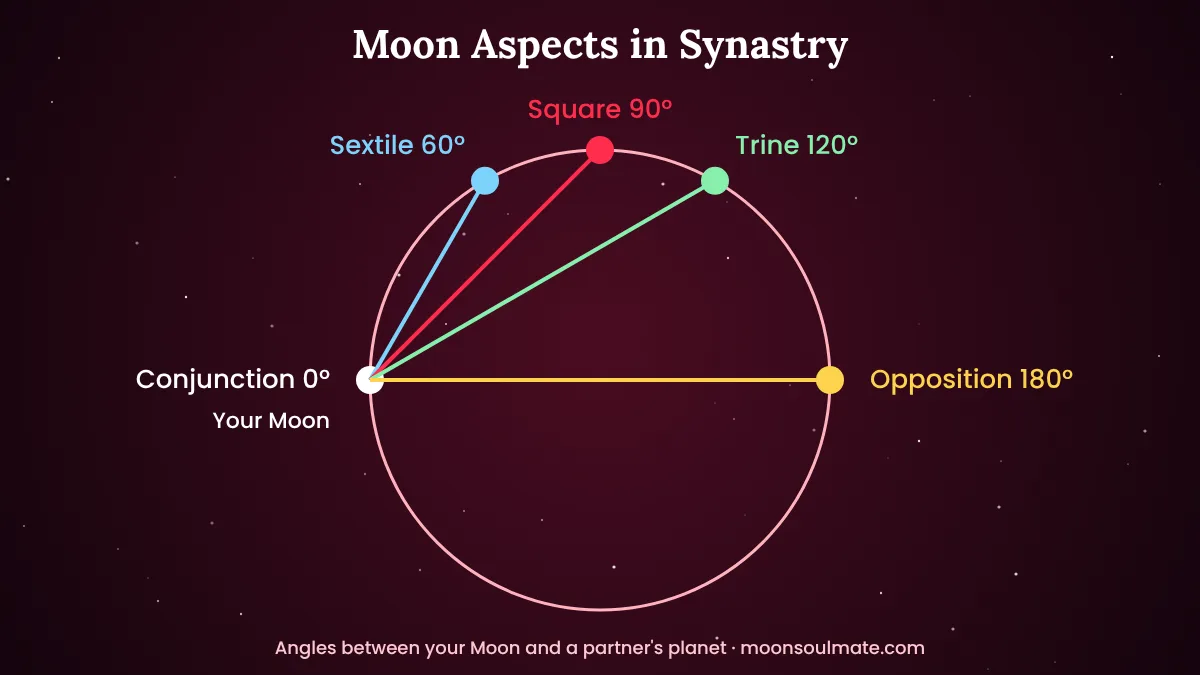
Astrologers differ slightly on orbs, but these ranges match common practice. Treat anything within 2 degrees as a defining contact of the relationship.
Step 4: Reverse the Comparison
Now repeat the whole process with your partner’s Moon against your chart. Synastry is two way. You may soothe your partner’s Moon beautifully while their chart barely touches yours, which can leave one person feeling well loved and the other quietly lonely. The healthiest charts show care flowing in both directions.
Step 5: Weigh the Whole Picture
Finally, step back. Count the supportive contacts and the challenging ones, and note which are tight. A single Moon square is not a breakup sentence, and a single trine is not a guarantee. Look for repeated themes. When three different contacts all point to “this person makes me feel safe,” you can trust that message.
Moon to Moon Aspects in Synastry
When two Moons connect, both people’s emotional natures speak to each other directly. These are among the most felt contacts in any chart comparison, so each one has its own detailed guide.
| Moon to Moon Aspect | Emotional Theme | Ease Level | Read the Full Guide |
|---|---|---|---|
| Conjunction | Emotional twins who feel at home | Very easy, sometimes too similar | Moon conjunct Moon synastry |
| Trine | Natural emotional harmony | Easy | Moon trine Moon synastry |
| Sextile | Friendly understanding | Easy with effort | Covered below |
| Square | Different needs that clash and teach | Challenging | Moon square Moon synastry |
| Opposition | Opposite needs that attract and balance | Mixed | Moon opposite Moon synastry |
Moon Conjunct Moon
Your Moons sit in the same sign and close degree. You react to life in similar ways, enjoy the same comforts and often finish each other’s emotional sentences. The gift is deep familiarity. The risk is that when you both feel low at the same time, nobody holds the other up.
Moon Trine Moon
Your Moons share an element, so your emotional styles flow together. Water Moons both value feeling, fire Moons both value enthusiasm, and so on. This is one of the most peaceful contacts in synastry and a classic sign of long term comfort.
Moon Sextile Moon
Your Moons sit in compatible elements such as fire and air or earth and water. You understand each other well, and the bond grows stronger the more you share. Sextiles reward couples who make time to talk.
Moon Square Moon
Your Moons sit in signs with different elements and goals. One may want closeness while the other wants independence, or one needs to talk while the other needs to act. Squares create friction, but they also create growth and a stubborn kind of attraction.
Moon Opposite Moon
Your Moons face each other across the zodiac. You see in your partner the emotional qualities you lack, which can feel magnetic. The work is to treat the difference as balance instead of a tug of war.
Moon Aspects to Other Planets
The Moon also speaks to every other planet in a partner’s chart. Each contact adds its own flavor to the emotional bond. Here is how the main ones work, with the most important explored further in their own articles.
Moon and Sun
Sun and Moon contacts are the classic marriage aspects in traditional astrology because they join the two lights of the chart. The Sun person feels admired and supported, and the Moon person feels warmed and protected. We explore the strongest versions in our guides to Sun conjunct Moon synastry and Sun opposite Moon in synastry.
Moon and Mercury
Moon and Mercury contacts show how feelings and words meet. Harmonious aspects mean one partner can explain what the other feels. Hard aspects can create misunderstandings when one person speaks logically to someone who needs emotional validation first.
Moon and Venus
Moon and Venus is one of the sweetest combinations in synastry. Affection and comfort blend, so the couple enjoys simple time together, from cooking to curling up on the sofa. The conjunction is especially loved by astrologers, and you can read all about it in our Moon conjunct Venus synastry guide.
Moon and Mars
Moon and Mars brings heat. The Mars person stirs the Moon person’s feelings, which can mean passion and protectiveness or irritation and hurt. Trines and sextiles tend to show healthy desire, while squares and oppositions call for careful handling during arguments.
Moon and Jupiter
Jupiter expands whatever it touches. The Moon person feels generously cared for, encouraged and lucky in the relationship. The only risk is overindulgence, such as spoiling each other or avoiding hard conversations to keep things pleasant.
Moon and Saturn
Saturn contacts are the glue of many long marriages. Saturn offers loyalty, structure and commitment to the Moon person. In hard aspects, the Moon person can feel judged, restricted or emotionally cold. Many couples describe Moon and Saturn as “serious from day one.”
Moon and the Outer Planets
Uranus, Neptune and Pluto move slowly and create intense, unusual Moon connections.
- Moon and Uranus: Exciting, unpredictable and freeing, but the Moon person may never feel fully settled.
- Moon and Neptune: Dreamy, spiritual and deeply compassionate, with a risk of illusion or rescuing.
- Moon and Pluto: Obsessive, transformative and powerful, with a risk of jealousy and control.
Moon and the Lunar Nodes
Contacts between the Moon and the North or South Node are often called karmic or destined. The South Node feels like a past life memory and instant familiarity. The North Node feels like growth and purpose. If you are curious about soulmate timing, read our guide to Moon conjunct North Node synastry.
Moon and the Ascendant
When one person’s Moon touches the other’s Ascendant, the bond is visible from the first meeting. The Ascendant person often looks and feels like “home” to the Moon person, and friends notice how comfortable the two of you seem together.
Quick Reference: Moon Contacts at a Glance
| Contact | Gift | Watch Out For |
|---|---|---|
| Moon and Sun | Mutual support, marriage potential | One partner dominating |
| Moon and Mercury | Talking through feelings | Logic versus emotion |
| Moon and Venus | Tenderness and shared pleasure | Avoiding conflict |
| Moon and Mars | Passion and protection | Hurtful arguments |
| Moon and Jupiter | Generosity and optimism | Overindulgence |
| Moon and Saturn | Loyalty and staying power | Coldness or criticism |
| Moon and Uranus | Excitement and freedom | Instability |
| Moon and Neptune | Spiritual tenderness | Illusion and rescuing |
| Moon and Pluto | Deep transformation | Jealousy and control |
| Moon and Nodes | Sense of destiny | Repeating old patterns |
| Moon and Ascendant | Instant comfort | Taking each other for granted |
Moon Sign Elements and Emotional Compatibility
Element matching is the foundation underneath every Moon aspect. Moons in the same element trine or conjoin each other, while Moons in clashing elements often square each other.
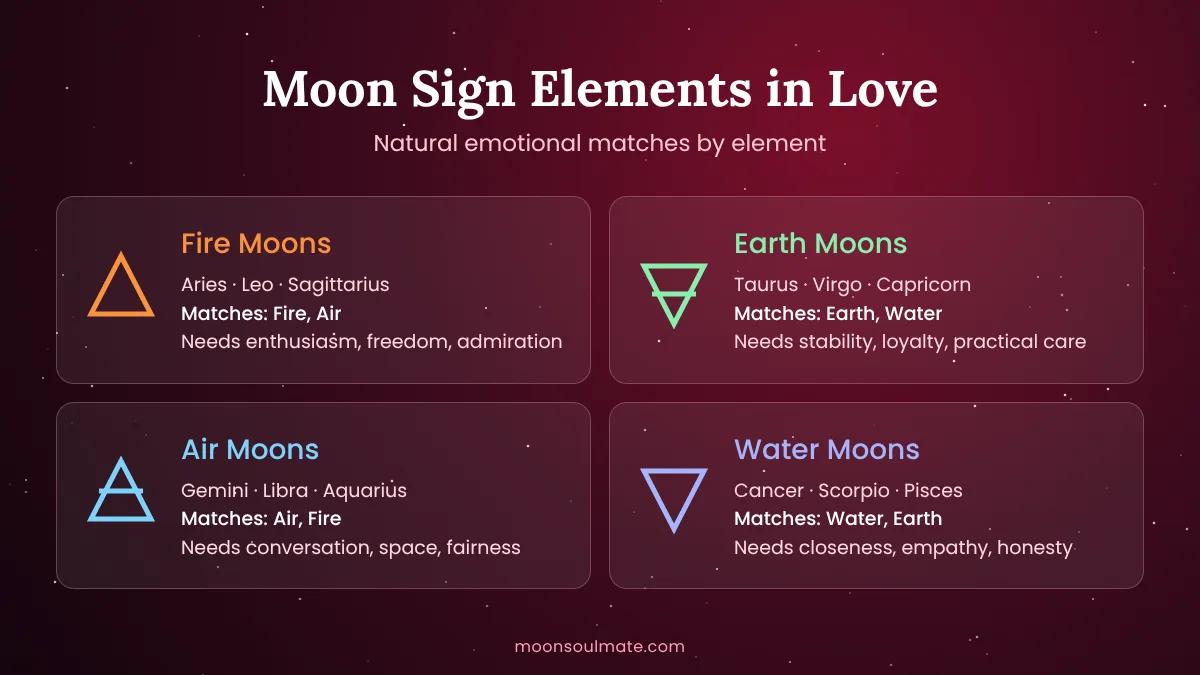
| Your Moon Element | Natural Matches | Growth Matches | Core Emotional Need |
|---|---|---|---|
| Fire (Aries, Leo, Sagittarius) | Fire, Air | Water, Earth | Enthusiasm, freedom, admiration |
| Earth (Taurus, Virgo, Capricorn) | Earth, Water | Fire, Air | Stability, loyalty, practical care |
| Air (Gemini, Libra, Aquarius) | Air, Fire | Earth, Water | Conversation, space, fairness |
| Water (Cancer, Scorpio, Pisces) | Water, Earth | Fire, Air | Closeness, empathy, emotional honesty |
A growth match does not mean the relationship cannot work. It means each partner needs to learn the other’s emotional language on purpose. For a sign by sign example, see our guide to Cancer compatibility with other signs, the sign the Moon rules.
Moon House Overlays in Synastry
House overlays show where your partner’s Moon lands in your chart, and therefore which part of your life they touch emotionally. You need both birth times to read overlays accurately.
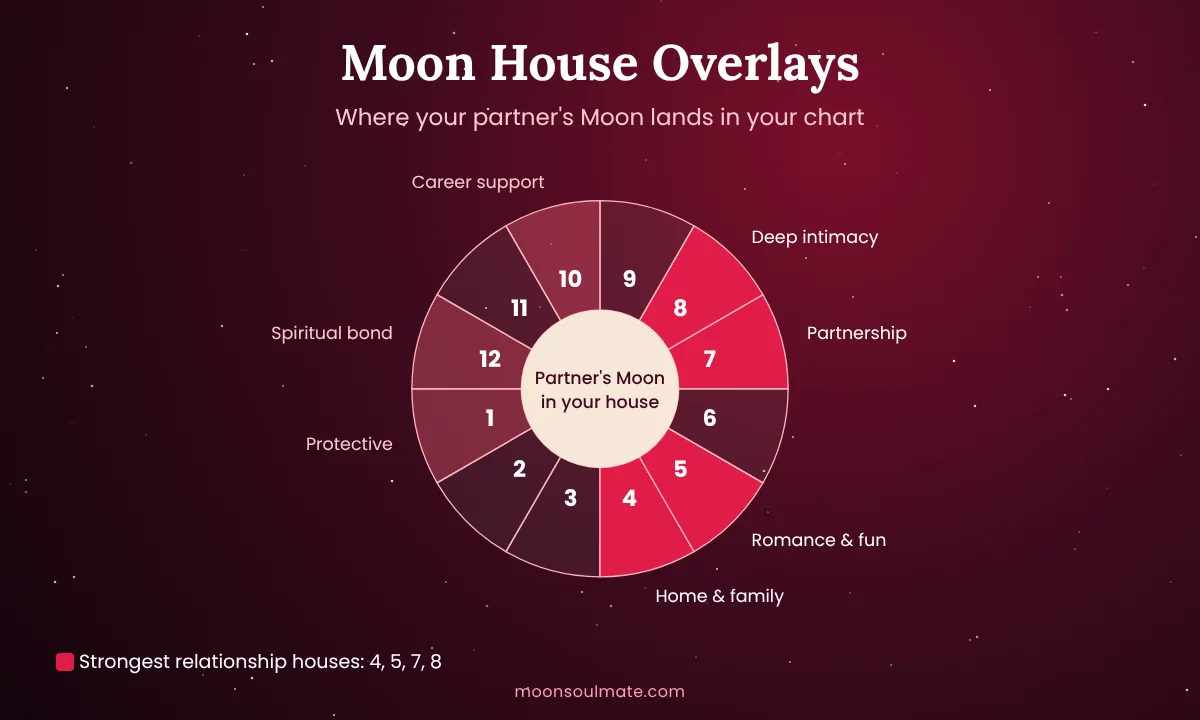
| Partner’s Moon in Your | What It Feels Like |
|---|---|
| 1st house | They respond to you instantly and feel protective of you |
| 4th house | They feel like family and home, a classic sign of nesting together |
| 5th house | Fun, romance and playful affection |
| 7th house | Strong partnership and marriage feelings |
| 8th house | Deep intimacy, vulnerability and shared resources |
| 10th house | Emotional support for your career and public life |
| 12th house | Spiritual, secret or hard to explain closeness |
The 4th, 5th, 7th and 8th houses are the most relationship focused. When a partner’s Moon falls in one of these, the emotional link tends to be strong and personal.
Signs of a Soulmate Moon Connection
There is no single “soulmate aspect,” but certain Moon patterns appear again and again in charts of couples who describe each other as soulmates.
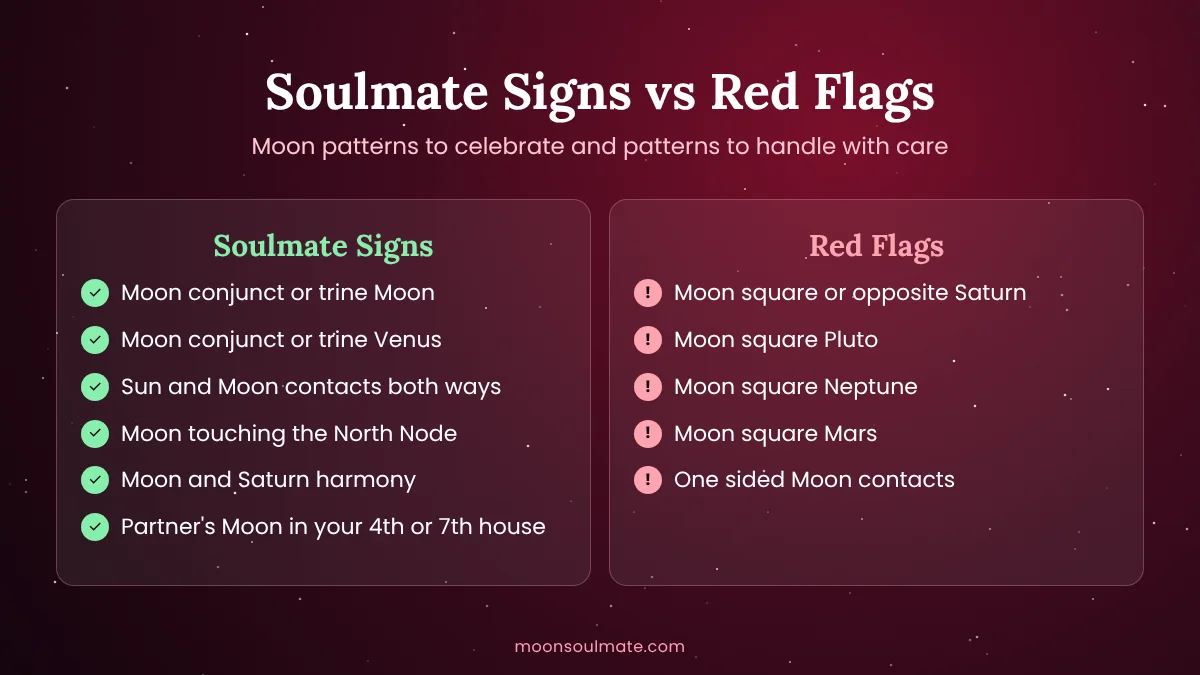
- Moon to Moon conjunction or trine within a tight orb, showing shared emotional instincts.
- Moon conjunct or trine Venus, showing tenderness that feels effortless.
- Moon and Sun contacts in both directions, which astrologers call a double whammy.
- Moon contacts to the North Node or Vertex, linked with fated meetings.
- Moon and Saturn harmony, showing a bond built to last through time.
- A partner’s Moon in your 4th or 7th house, showing family and commitment themes.
When several of these appear together, the relationship usually feels familiar from the first conversation. If you want to explore the difference between soulmates and other intense bonds, our guide to twin flame vs soulmate breaks it down.
Red Flags in Moon Synastry
Challenging aspects are not reasons to walk away, but they do show where a couple must be careful.
- Moon square or opposite Saturn: one partner feels criticized or emotionally starved.
- Moon square Pluto: power struggles, jealousy and control around feelings.
- Moon square Neptune: idealizing a partner, then feeling deceived.
- Moon square Mars: fights that cut deep and are slow to heal.
- One sided contacts: one person’s Moon is well supported while the other’s is ignored.
Awareness is the remedy. Couples who name these patterns early can agree on how to handle them, for example scheduled check ins for a Saturn contact or cooling off rules for a Mars square.
Moon Synastry vs Moon Phase Compatibility
Moon synastry needs exact charts. Moon phase compatibility needs only birth dates. It looks at the lunar phase each person was born under, such as a New Moon or Full Moon, and compares the emotional rhythm each phase brings.
The two methods work well together. Synastry shows specific emotional contacts, and moon phase compatibility shows how your life rhythms fit. You can learn more in our guide on how your moon phase shapes the way you fall in love, or get an instant reading with the moon soulmate compatibility test on our homepage.
What the Data Says About Astrology and Love
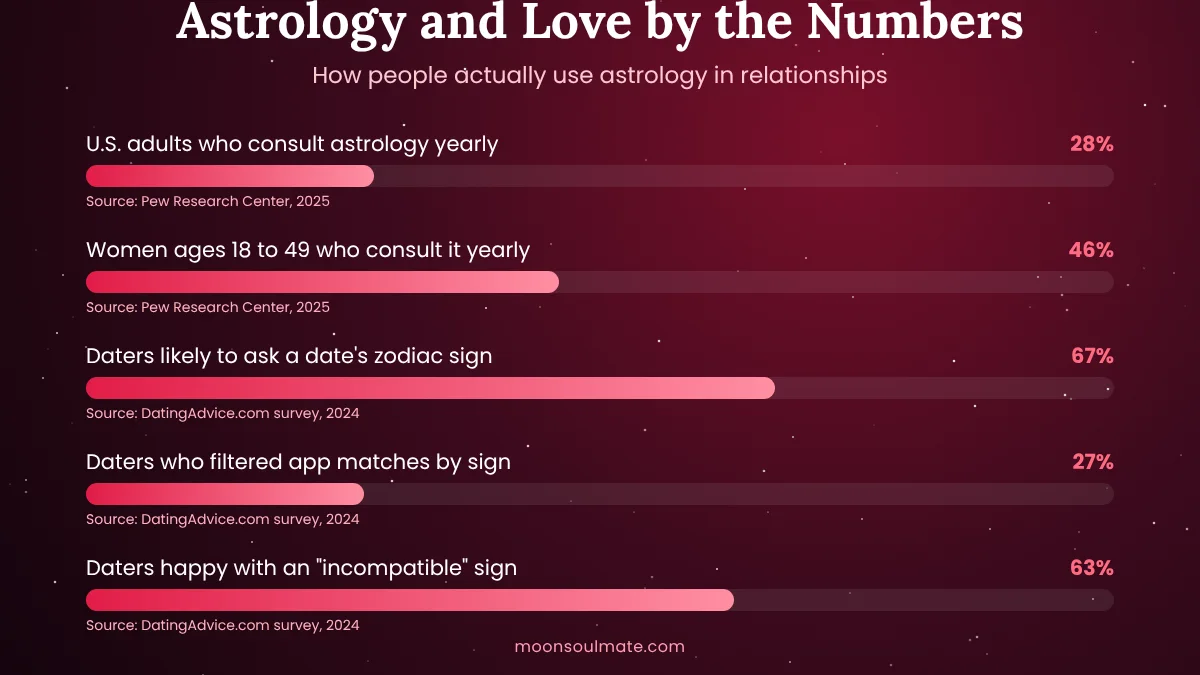
Astrology is a reflective tool, not a laboratory science, and it is honest to say so. Encyclopaedia Britannica describes it as a practice of interpreting the influence of celestial bodies on human affairs, and it has not been confirmed by controlled scientific study. Still, many people use it to understand themselves and their partners, and the numbers show how common that is.
| Finding | Figure | Source |
|---|---|---|
| U.S. adults who consult astrology or horoscopes at least once a year | 28% | Pew Research Center, 2025 |
| Women ages 18 to 49 who consult astrology yearly | 46% | Pew Research Center, 2025 |
| U.S. adults who believe in astrology | 27% | Pew Research Center, 2025 |
| Adults who rely on astrology “a lot” for major decisions | 1% | Pew Research Center, 2025 |
| Daters likely to ask about zodiac signs on a first date | 67% | DatingAdvice.com survey via PR Newswire, 2024 |
| Daters who have filtered app matches by zodiac sign | 27% | DatingAdvice.com survey, 2024 |
| Daters who had a good relationship with an “incompatible” sign | About 63% | DatingAdvice.com survey, 2024 |
The last figure is the most useful lesson of all. Compatibility charts describe tendencies, but people build relationships. Use Moon synastry to understand needs and start conversations, not to rule anyone out.
Frequently Asked Questions About Moon Synastry
What is the most important aspect in Moon synastry?
Many astrologers rank Sun and Moon contacts and Moon to Moon contacts as the most important, because they show basic emotional support. Moon and Venus and Moon and Saturn come close behind for romance and staying power.
Can a relationship work with no Moon aspects?
Yes. Some couples have few direct Moon contacts and still thrive through strong Venus, Saturn or Ascendant links. Without Moon contacts, partners simply need to talk more openly about emotional needs because those needs are not met automatically.
Do I need an exact birth time for Moon synastry?
An exact time gives the most accurate Moon degree and makes house overlays possible. Without one, you can still read Moon sign and wide aspects, but tight orbs and overlays become guesses.
Is Moon square Moon bad in synastry?
Not necessarily. It shows different emotional needs that create friction, and many lasting couples have it. The square becomes a strength when both people learn to meet a need they do not personally share.
What is a double whammy in Moon synastry?
A double whammy happens when the same planetary pair connects in both directions, such as your Moon aspecting their Venus and their Moon aspecting your Venus. It strengthens the theme of that contact.
How is Moon synastry different from my Moon sign?
Your Moon sign describes your own emotional nature. Moon synastry describes how that nature interacts with one specific person’s chart.
Find Your Moon Soulmate Match Today
Moon synastry shows the emotional truth of a relationship: what each partner needs, who supplies it naturally and where both of you must grow. Start with each Moon on its own, map the aspects with their orbs, read the comparison in both directions and then weigh the full picture rather than any single contact.
Ready to see how your emotional rhythms fit? Take the free moon soulmate test on our homepage. It takes less than a minute, and it is the perfect first step before you explore your full synastry chart.